Let's talk about witches!
What does it mean to be a witch? A friendly definition, of sorts.
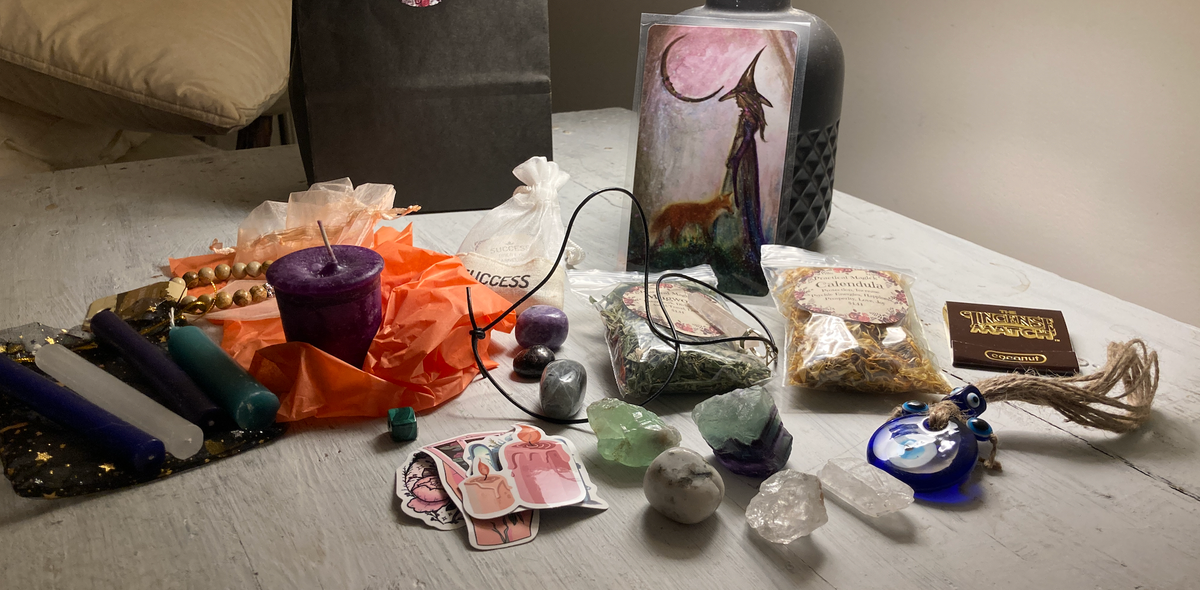
It’s time to clarify a few things.
For the first 18 years of my life, I lived a version of anything-not-fundamentally-religious was evil. My nickname in high school was “Jesus Girl.” When I was 12 and began having my first thoughts about queerness, our beloved pastor was outed by the associate pastor and sent to Gay-Be-Gone camp. I went so far back into the closet that I didn’t even know I was queer until I was 44. I grew up so super Christian that we couldn’t trick-or-treat because it was considered the d3vil’s (capital D) holiday. Instead we went to Harvest Festivals at the large Presbyterian church my family attended.
The irony of celebrating a harvest festival at my evangelical church is not lost on me now. Halloween, Samhain, is the second (and last) harvest festival of the year for many who call themselves witches, and it is often considered to be our New Year. It was and is a so-called pagan holiday, co-opted by the church and then by commercialism. (The word ‘pagan’ itself is potentially problematic, as its history may be traced to Christians who used it as a way to derogatorily demarcate the Other who didn’t believe what they did.)
Samhain starts off a year of growth: from nothing (the darkness, as we enter winter) to the light and first growth of spring, then the burgeoning of summer, and onto the two fall harvests (August and October). Harvest festivals are ones of joy, community, and utmost the changing of the seasons. They are not devil holidays, and witches are not devil worshippers.
While there are many varieties of being a witch, I don’t know a single one who would say we “worship” anything. And that's likely why some churches have a problem with witches. Organized religion in the broadest sense is meant to keep people under control. And they do that through requiring a populace to worship a (white, male) God. That’s white supremacy. I am not here to argue any of these facts about religion. Even Wicca, a religion made up in the 1940s by a white guy named Gerald Gardner, has some pretty gross heteronormative white power issues with it, so there’s plenty of witches who do not see Wicca as a precursor to their own spiritual practice.
Yes, witchcraft can absolutely be a spiritual practice where we connect to the divine (little d or big D, if you prefer). When we speak of the divine, we’re not talking about Jesus or God (but, also, we might be…depending on one’s traditions). Typically, we mean something more encompassing: Spirit, the Universe, Universal Energy, Nature, Earth Mother, etc. (with capitalization or not, as one desires). For me, Jesus is equivalent to the Buddha or [insert other earthly religious figures]. Reiki and other healing practitioners often refer to these folks as the Ascended Masters, if that helps. Sure, they’re [dead] people called on for support, but they’re not to be worshipped in a religious, bow-down sense. That’s what your Golden Oval Offices are for.
Also, witches don’t have to be spiritual to be witches. They can just be everyday practitioners: kitchen witches, esoteric witches, bog witches, librarians. (Heh. I joke, but also, witches are the communal knowledge keepers. That’s why they keep trying to kill us, because knowledge is actual power.)
Witchcraft is how we practice: the craft of being a witch. Witches use rituals and spells (equivalent to church services and prayer in Christian terms) and tools. A ritual is just an action set forth with intention, often repeated for clarity or effect. A spell is just an intentional use of words. The Lord’s Prayer repeated every Sunday during church service? It’s a religious ritual with a built-in spell. Was there incense or a lit candle? That’s a spiritual tool.
Let’s go more mundane: Sunday soup of vegetables you whispered or sang to everyday in your garden and made with love using meemaw’s gnarled recipe card? An ancestral spell to keep the family healthy cast in your crockpot/cauldron. Did you stir it 17 times an hour while imagining your chosen family enjoying it? That's a manifestation ritual. Did that same meemaw ever make you chew spring onions when you had a toothache? That herbal remedy may have been passed down through seven generations of women (and sometimes men, and often queers). Witches are the original feminists.
Regardless of a witch’s traditions, their connection to the (super)natural world is what holds the term ‘witch’ together for many of us. You ask a woman who is into the phases of the moon and transits of the planets, or the way certain stones look in the sunlight, or how the trees and flowers grow on the land, or the way the seasons affect the community of humans and other natural beings (plant and animal) around her…and bonus if she’s into tarot or astrology or yoga or sound baths or somatic healing (tools that give witches more specific language for their practice) … and she may have never used the word “witch” to define herself to others, even for all the magic she is bringing into the world through her practice. But, as more of us come to the fore, she may—like I wished at 12 to have a language for what I was experiencing—soon realize she is in a community of practice: What witches would call a coven.
This is all to say that to define a witch is to define a person intentionally attending to their connection with the Earth’s elements (fire, water, air, earth, and ether, if you like). Beyond that, the sky is not even the limit for how a witch might present in the world, or whether she publicly calls herself one. Your job is to allow her the space to do so, should she choose. Because she will make it more magical.
Now, what to do with this information? Share it with your friends. Correct someone who makes an ignorant statement about witches. Boycott non-inclusive churches. Support your queers and witches.
Thank you to my teachers over the years who have helped me have language for the work that I do, especially Jane Pierce, who first taught me about the close relationship between church and tarot.